
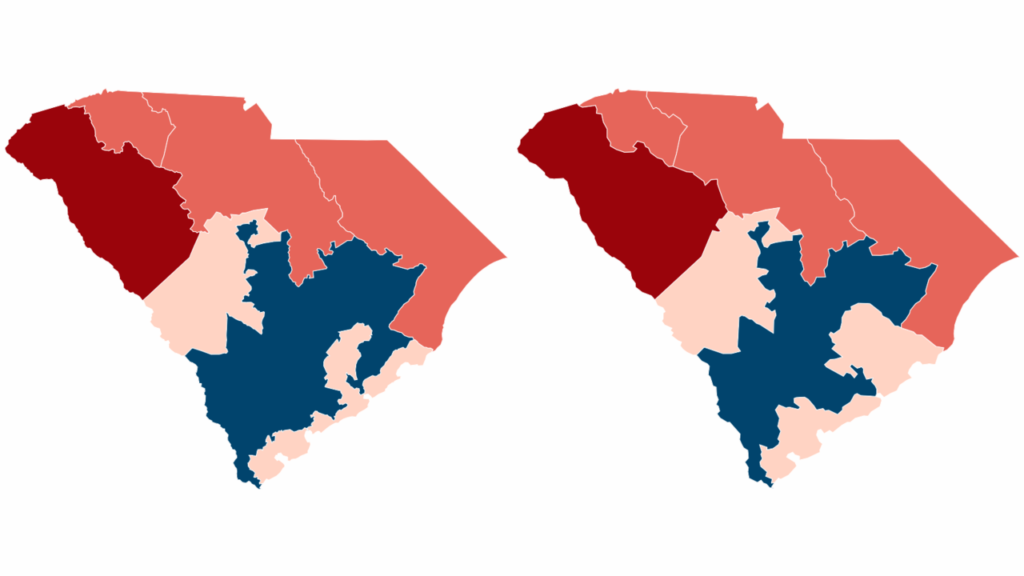
If you’ve been remotely abreast of the news in our state, then you’ve most likely heard the word “redistricting” being thrown around in Columbia. While the State House and Senate have reached Sine Die, essentially have held their last session, they may still come together to discuss whatever topics they approved for themselves beyond Sine Die. One of these topics is redistricting.
Why are we discussing redistricting now?
Redistricting now is in vogue across the country because of the landmark SCOTUS decision, Louisiana v. Callais. (A summary can be found here: https://statecourtreport.org/our-work/analysis-opinion/aftermath-callais)1 Previous to Callais, districts were required to adhere to principles guided by the Voting Rights Act, essentially creating districts that in practice reflected where ethnic minorities lived and voted. Redistricting guidelines for partisan gerrymandering and incumbent protection in the American South, where districts were drawn to support minority populations, are now gone.
Redistricting Rules
Redistricting must now consider these rules exclusively2:
- Districts must have contiguous borders, meaning lines must be unbroken (districts connected by water are acceptable)
- Districts must be relatively straight drawn/compact and must follow census-block geography
- Districts must consider factors such as: Economics, social/cultural influence, Voter history/political beliefs, Geographic location, Municipal boundaries/precinct lines
Most importantly, when drawing maps to redistrict, the redistricting committee must use census data from the state decennial census, a fancy word for a census that takes place every ten years. Therefore, any redistricting propositions must use data from 2020.
- Why Redistrict Now?
South Carolina is no exception. Jim Clyburn’s Third Congressional District is our state’s minority-district-of-choice on the 2020 district map. The redistricting committee can be called upon at any time to draw a new map, using the census from 2020. For example, even before Callais, there was pending redistricting legislation in December of 2025. At the time, this map would still have had to adhere to the Pre-Callais rules.
The current map, now outdated by the Callais decision, says that voting districts should not be racially determined when drawing their map for congressional, state and local districts.3
- Why Have Lawmakers Gone Quiet Until June 10?
SC House and Senate Legislators are also politicians. The Callais ruling may affect their district. Their currently protected districts could become challenged with a costly re-election campaign and lawsuits.
Also, a suit can be brought using the Purcell Principle, a judicial standard that dictates a FEDERAL Court could not change state election rules too close to an election. While we are all well aware that Federal Courts are not in charge of redistricting, Purcell could be construed in a potential suit that the election “rules” here are being changed too close to an election. It is also generally just good public policy not to redistrict immediately before an election.4
On one hand, lawmakers can redistrict Clyburn’s Congressional Seat to become compliant with the current SCOTUS ruling at the risk of disturbing current State House and Senate seats and risk lawsuits using the Purcell Principle. If lawsuits ensue, other districts could be redrawn prior to the 2030 census.
On the other hand, they can decide not to redistrict and wait until the 2030 census, leaving the district maps questionably unconstitutional.
- Alicia Bannon, “The Aftermath of Callais,” State Court Report, May 7, 2026, https://statecourtreport.org/our-work/analysis-opinion/aftermath-callais. ↩︎
- National Conference of State Legislatures, “Redistricting Criteria,” last modified June 26, 2025, https://www.ncsl.org/elections-and-campaigns/redistricting-criteria. ↩︎
- Louisiana v. Callais, 608 U.S. ___, No. 24-109 (2026). ↩︎
- Democracy Docket, “The Purcell Principle,” accessed June 5, 2026, https://www.democracydocket.com/purcell/. ↩︎