
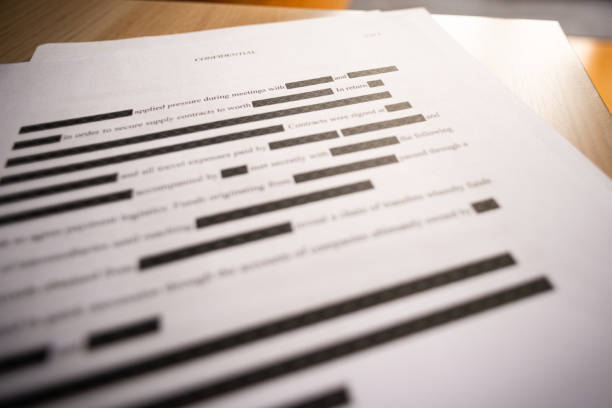
Government agencies are starting to let artificial intelligence help decide which records answer a public records request and what gets blacked out before release. In most places, including South Carolina, these agencies aren’t required to tell the requester that they used AI.
The federal government is the furthest along with using AI for FOIA redactions. The Washington Post reported that U.S. Customs and Border Protection plan to use Google’s AI and machine learning tools to recommend redactions to its FOIA officers (Washington Post). DHS told the paper it would apply the tools to request types making up more than 10% of its caseload, roughly 100,000 to 140,000 requests (Washington Post). Interior uses Microsoft technology to flag possible attorney-client material, Justice uses a Veritone product to redact video, and HHS is building a tool called “FRED” with an unnamed contractor (Washington Post). None of this is unusual anymore. According to the National Archives, one-fifth of federal agencies have started using machine learning to help with FOIA requests (Washington Examiner; OGIS survey).
The states are following. This summer the California Highway Patrol signed a multi-year contract to use Veritone Redact to automate the redaction of sensitive information in digital evidence (Veritone). David Cullier of the University of Florida’s Brechner Center told the Post that AI redaction could become a “very powerful tool for secrecy” if no one watches closely (Washington Post)
Where the Real Risk Lies
The scenario people tend to imagine is a hidden instruction telling the software to bury embarrassing documents. That could happen, but it’s not the likeliest way things go wrong. Three quieter problems deserve more attention.
The first is tuning. A model told to be careful about privacy or privilege will flag more than an experienced records officer would. Each individual call may look defensible. Across thousands of pages, though, a slight lean toward caution turns into a lot of information withheld that the law says should have been released.
The second is review. Every agency says a person signs off on the AI’s suggestions. When an office is months behind, that review can shrink to approving recommendations in batches, and nobody outside the agency can tell the difference. One analysis of the federal rollout found no evidence that the agencies involved publish error rates, keep logs of which AI recommendations staff accepted or rejected, or tell requesters that AI played any role (Gadget Review).
The third problem matters most to anyone who litigates record requests, AI at the search stage. Before anything is redacted, someone decides which records respond to the request at all. A redaction announces itself. The requester sees the redaction and can challenge it. A record that an automated search screened out as non-responsive leaves no mark anywhere. There’s no gap in the page numbers and no entry on an exemption log, so unless the requester already knows the document exists, there’s nothing to appeal.
The Law Already Expects Careful Judgment
Federal FOIA requires agencies to release information unless they reasonably foresee that disclosure would harm an interest an exemption protects, and to release any portion of a record that can be reasonably separated out. The D.C. Circuit has called these separate questions that must be answered in order (Leopold v. DOJ). The National Archives’ FOIA ombudsman has said AI cannot replace a FOIA professional’s judgment on exemptions and foreseeable harm (OGIS). It is clear that people need to be the ones redacting FOIAs, not AI.
California’s experience shows how a generic tool can collide with specific laws. Veritone describes the Highway Patrol’s job as stripping personally identifiable information such as faces, license plates, and medical details before release (Veritone). California law has no blanker exemption for that kind of information. For video of police shootings and similar incidents, an agency may blur footage only after showing, on the facts of the particular case, that a privacy interest clearly outweighs public disclosure. It must explain that reasoning in writing to the requester, and the redaction cannot keep a viewer from fully and accurately understanding what happened (Cal. Gov. Code 7923.625). Software that blurs every face makes none of those case-specific judgments.
There is useful comparison in civil litigation. In 2012, a federal magistrate judge in New York held that computer-assisted review is an acceptable way to search electronically stored information, and one factor he relied on was the “transparent” review process the defendant proposed (Da Silva Moore v. Publicis Groupe). The court emphasized that cooperation and disclosure. The court emphasized that cooperation and disclosure about search methods and testing can reduce disputes and support approval of a review protocol. Litigants have been able to see and contest how machines searched for documents for more than a decade. Public records requesters currently get nothing comparable
What Other States Have Done
No state appears to regulate specifically how AI may be used to process public records requests. A few have adopted measures that point the way. Washington’s State Archives advised in June 2024 that if a generative AI interaction, both input and output, relates to public business, it is a public record, and that using a personal AI account for agency business still creates public records (Washington State Archives). Seattle’s AI policy goes further, stating that all records generated, used, or stored by generative AI vendors or solutions may be considered public records and must be disclosed upon request (MRSC).
Georgia’s state technology standard directs agencies to retain audit trails of prompts, responses, and reviews, and to prepare for potential disclosure of GenAI-related records (Georgia Technology Authority, SS-25-001). That audit trail is exactly what a requester would want to see. Montana’s 2025 law requires that when an AI system produces a recommendation or decision for a government entity affecting someone’s rights or privileges, a human must review it and may reject or modify it (Orrick AI Law Center; Mont. Code § 2-21-103). Whether a FOIA withholding counts as a decision affecting a requester’s rights hasn’t been tested, but the argument is a natural one. Texas’s New AI law, by contrast, is narrower than it sounds. It requires governmental agencies that make that make AI systems available for consumer interaction to disclose that the consumer is interacting with AI system (Alston & Bird). That covers chatbots, not back-office redaction. (ABA Communications Lawyer)
South Carolina Today
South Carolina’s FOIA itself gives requesters a solid footing. It defines public records to include documentary materials regardless of physical form or characteristics that a public body prepares, owns, uses, possesses, or retains (S.C. Code § 30-4-20). Vendor contracts, configuration files, prompt documents, and system logs fit within that language. The statute gives people a right to inspect and copy records (S.C. Code § 30-4-30), though, not a right to have questions answered or new documents created. That distinction shapes what requesters should do, but having AI redact files automatically is harmful to what requesters can do.
What can be done now
Requesters don’t need new legislation to start. Every South Carolina FOIA request can include a short paragraph asking whether AI or other automated tools were used to search for records, decide what was responsive or exempt, or recommend redactions; which tool and vendor were involved; what instructions or settings the tool was given; and whether a staff member individually reviewed each withholding. An agency may decline to answer those questions. The paragraph should therefore end by requesting the contracts, configuration documents, prompts, usage policies, and logs connected to the tool’s use on that request. Records that already exist are much harder to refuse than questions.
Requesters can also seek the AI setup on its own terms, apart from any particular request, and send a short baseline request to the agencies and local governments sued most often, asking what AI tools they use for records work and what policies govern them. The answers would give South Carolina the inventory it doesn’t yet have.
Legislators have ready models. They could require public bodies to state in each response whether AI was used to search, review, or redact records, and name the tool. Following Georgia and Montana, they could require human review of every AI-recommended withholding, with logs of what was accepted and rejected. Following Washington and Seattle, they could declare AI prompts, outputs, and configurations public records and build export rights into vendor contracts. And they should reject blanket FOIA exemptions for AI documentation.
There’s also the question of who builds these tools in the first place. When an agency licenses a product like Veritone Redact, a private company ends up sitting between the public and its own records, deciding through its software what gets released and what gets redacted. The agency pays for that service with public money. Yet if a citizen wanted to test how the software handles a hundred different requests, or simply see the rules it follows, the vendor would likely call its methods a trade secret.
There is no obvious reason it has to work this way. A state could ask its public universities and a small panel of independent experts to build a redaction tool tailored to its own transparency laws, with its design, settings, and test results open to anyone who wants to examine them. A tool developed in public and accountable to the public would deserve far more trust than a proprietary product sold to agencies as a convenience.
Overall, faster responses would be welcome in a system where delay often amounts to denial. But a public records law exists so people can check the government’s work. A process that hides how it decides what you see, and what you never learned existed, works against that purpose. Until agencies can document in detail how and where they came up with their responses, they shouldn’t hand these decisions to software.